Prefer to Listen?
Subscribe to our podcast to listen to this week’s episode on your favorite podcast platform (Available 2/25/26).
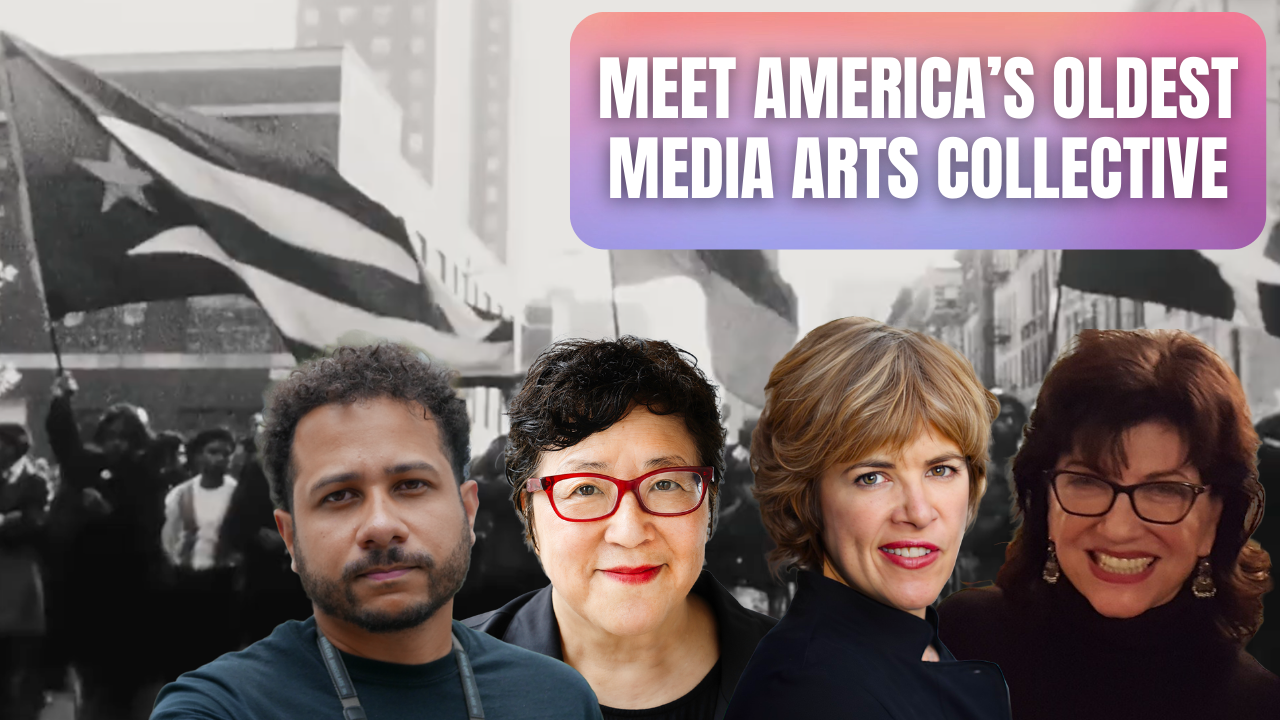
It’s almost unheard of for an independent media collective to survive as long as Third World Newsreel has. Since 1968, they have chronicled some of the most pivotal movements in human history and continue to expand on their collection of over 700 titles. There’s lots to learn about how they’ve adapted through technological revolutions, political persecutions, philanthropic booms and busts — and how they’re making do in today’s “media carnage”, as Laura Flanders puts it. Joining us are JT Takagi, an independent filmmaker, sound recordist, and the longtime executive director of Third World Newsreel. Tami Gold is an artist and activist whose documentaries grapple with everything from imperialism to sex work. Her films include My Country Occupied, Another Brother and Land, Rain and Fire among many more. Puerto Rican-born Juan Carlos Dávila works in film as well as TV, where he reports on social movements around environmentalism, militarism and the struggles of the working class on the island. His films include The Stand-By Generation, Viequez: An Endless Battle and Drills of Liberation. Join us as we look at the past, present and future of Third World Newsreel and ask how film can be used as a tool for organizing.
“I’d say we feel more urgent now than ever before. Every day there’s something happening that makes it clear that our rights and liberties, and people’s lives all over the world are at stake. Not being in touch with the history and media that shows the truth of what’s going on is really decimating people’s ability to, as Juan said, know what to follow and what to do.” – JT Takagi
“We need to retake the theater, the physical space that is being ignored by the corporations. Perhaps now that is the opportunity that we have . . . A theater is being rented by people who are organizers, and they’re using their collective spirit and know-how to organize huge, huge crowds to come.” – Tami Gold
“People can shoot stuff with the phone . . . I see a lot in Puerto Rico that people are still wanting to produce with the corporate industry standards. Many young filmmakers like myself tend to think that we need so many personnel to be doing films. Right now we can actually make films with less.” – Juan Carlos Dávila
Guests
- Juan Carlos Dávila: Documentary Filmmaker, Multimedia Journalist, Puerto Rico Correspondent, Democracy Now!
- Tami Gold: Filmmaker, Artist, Activist
- JT Takagi: Executive Director, Third World Newsreel
Transcript
Show full transcript
LAURA FLANDERS & FRIENDS
THIRD WORLD NEWSREEL: SIX DECADES OF ACTIVIST MEDIA FOR SOCIAL JUSTICE
Watch | Download Podcast – Uncut Interview | Download Podcast – Episode
LAURA FLANDERS: Founded in 1967 amid the anti-war, anti-colonial and Black freedom struggles of that time, Third World Newsreel has survived for nearly six decades through technological revolutions, political persecutions, philanthropic booms and busts to right now, a time of media churn and let’s just say it, carnage. It is an almost unheard of lifespan for an activist media organization of any kind. This time on Laura Flanders & Friends, we are going to look at the past, present, and future of Third World Newsreel. Today, it’s a progressive alternative media center working to advance storytelling and media arts for cultural and social justice. In 1967, it was called The Newsroom.
– [Activist 1] And we’re going to grow in Chicago until Tom is out of jail, until Wolf is out of jail, until the Indian who is walking down the street is out of jail.
– [In unison] We want war. We want war.
– [Interviewee] The newspapers and television, more or less branded our husbands as criminals.
– [Narrator] The police were not here to create disorder, the police were here to preserve disorder.
– [Activist 2] We believe that politics is the way you live your life.
– [Activist 3] We are also divided because men don’t see us women as workers like themselves.
LAURA FLANDERS: That’s just a taste of the work of the original Newsreel. Today, the Third World Newsreel collection features over 700 titles from more than 400 filmmakers. And we have two award winners with us now. Tami Gold is an artist and activist whose documentaries grapple with everything from imperialism to sex work. Her films include “My Country Occupied”, “Another Brother”, and “Land, Rain and Fire” among many more. Puerto Rican-born Juan Carlos Dávila works in film as well as TV, reporting on social movements around the environment, militarism and the struggles of the working class on his island. His films include “The Stand-By Generation”, “Vieques: An Endless Battle” and “Drills of Liberation.” And last but not least, we’re joined by JT Takagi, a filmmaker and sound recordist in her own right. She’s also the executive director of Third World Newsreel, where she has been for many years. So how do they do what they do? Why do they keep it up? What lessons do they have to teach? I am very glad to welcome you all to Laura Flanders & Friends. Thanks for joining me. Let’s start, as I often do on these programs, just to kind of settle us because there’s so much happening in the world. What is on the top of your mind, in your heart as we begin this conversation, Tami?
TAMI GOLD: Well, the fight to keep the right to speak, the fight to keep the channels open of all media specifically, and first and most importantly, alternative media, progressive analytical media, investigative media, both journalism, news, documentary in all its forms. And we see that the attempts on crushing that every day.
LAURA FLANDERS: Thank you, Tami. What about you, Juan?
JUAN CARLOS DÁVILA: Right now, I feel we are so over drained with AI, social media, that people are confused. And this noise brings a lot of confusion and I think it is very important what us filmmakers and other type of workers of the media are doing right now. And it’s important that we take a stance.
JT TAKAGI: Our communities, our histories are, there’s huge attempts to erase them. And that’s I think part of the duty of the Newsreel is, to preserve and keep the films that have been made by the organization and by groups like ours, which is why we distribute so many other things because people are attempting to actually get rid of those films and to not show them and to change what history is. And we’re hoping to stave that off while we’re also focused on training the next generation of conscientized filmmakers.
LAURA FLANDERS: Well, that’s why I’m so glad to be having this conversation. And let me ask you, JT, to continue a little bit with the story of Third World Newsreel, began as the Newsreel in the 1960s. Can you take us back to that time and describe the kind of political context in which it was born?
JT TAKAGI: In the late sixties, we’re talking about, it was in the height of the Vietnam War. It was at the growth of Black empowerment, of Latinx empowerment. There were a lot of groups. That was also a time period when Asian American movement just came into a concept among people, women’s movement. Well, a lot of things were in motion. There’s some similarities to what’s happening now in terms of repression and attempted censure of groups. So at that time though, you had a bunch of filmmakers who were activists on their own right, making films about protests and things like that, and not seeming to make headway on their own. And they decided finally to work together as a collective to pull their footage together and start making films as a group and figuring out ways to get that somehow funded.
LAURA FLANDERS: Tami, did I hear correctly that you were 20 when you first connected with Third World Newsreel?
TAMI GOLD: Yes, I was 20 years old and I had just come back from hitchhiking in South America and Central America, and I had all these photographs and when I went to show them to people in Newsreel to say, “Hey, you know, look what I have, I have all this rich material.” They said, “It’s still photography. Go back, get film, get a camera and do the same thing and film it.” And so we were lucky, we got a grant, very small grant, at the time was $2,000. And we met with somebody who sold us a camera in a brown paper bag. We met him on 42nd Street. He gave us the bag. We gave him $200. We had never shot with a 16 millimeter camera, any camera. And we learned really fast. I think the way to look at it is Newsreel was my college. Newsreel is where I learned filmmaking, social justice organizing and consciousness of who I was.
LAURA FLANDERS: Well, we have a clip here from your 1972 film, “My Country Occupied.”
– [Narrator] I am Guatemalan, my country occupied. My home, a united fruit plantation. We have good soil here. The volcanoes and the rain make it so rich, we only have to drop the seeds and everything grows. Banana, azúcar, café, de todo. But this land, this land has been robbed from us. We plant the seeds, we take care of them, and then we pack them to be sent to the United States away from our hungry people.
LAURA FLANDERS: Juan Carlos, coming to you, your films focus on occupations too, specifically the occupation and politics around Puerto Rico. What’s been the significance of Third World Newsreel to your life and how did you come to connect with these two?
JUAN CARLOS DÁVILA: I was living in New York 2016, I believe, and I was showing my documentary, “The Stand-by Generation” on the Workers Unite Film Festival. And the folks over there talk to me, that I should reach out to Third World Newsreel because they distribute films that are politically and socially oriented in the educational markets. So I started, you know, my relationship with Third World Newsreel through those two films, a short film, “Stand-by by Generation” and “Vieques: An Endless Battle”. And I think, you know, one of the things that for me, very important about Third World Newsreel, I already knew about them and had a lot of admiration before actually, you know, meeting them. And I think one of the things for me as an independent filmmaker that I am committed to making films that have some sort of social impact, is that they present a model on how you can sustain, you know, making films. And that model also in involves a consistency because as you mentioned earlier, you know, so many decades doing this, it is very important. And also when I go back and you know, there’s so many obstacles when you make a film and you- and I have even thought, is this film going to be my last film? Because there’s, I mean, every film is such a hassle, such a hassle. That then you go, well, you know, the ones that have stayed for a long time and has made great contribution is the consistency regardless of having difficult times. So, for me, you know, Third World Newsreel is one of those media organizations that really reaffirms the calling that I have to make films.
LAURA FLANDERS: I mean, everything you’re saying just reminds me how urgent the work of Third World Newsreel and the filmmakers that are part of the collective remains. And to give people a taste of your work, here’s a clip from your film, Juan, from 2021, “Drills of Liberation“, this one about the impact of fiscal austerity on the island and Hurricane Maria and its aftermath.
– We are dying here.
– Now, I hate to tell you Puerto Rico, but you’ve thrown our budget a little out of whack.
– Yankee go home! Yankee go home!
LAURA FLANDERS: Coming back to you, JT, that question of urgency. Do you still feel it as keenly as you did back when you began with the Newsreel?
JT TAKAGI: I’d say we feel it’s more urgent now than ever before. I mean, every day there’s something else happening that makes it clear that our rights and our liberties and people’s lives all over the world are at stake at this point. Not being in touch with the history and media that shows the truth of what’s going on is really decimating people’s ability to, as Juan said, know what to follow and what to do.
LAURA FLANDERS: So how are you cultivating the next generation of filmmakers? I would imagine it’s a pretty daunting message. This is really, really, really hard work. Come join us.
JT TAKAGI: Well, it’s hard and it’s not as hard as, I mean, at least now people have, can film on their phones, so that can make things easier. I think people still are lacking access to, well, what do you do once you have that phone and what can you do with the material afterwards? We do a series of free seminars during the year, both fall and spring. We also have a production workshop that takes 9 to 10 people over a six-month period and gets them from basically zero to creating a short film. And we specifically select people who are either directly involved in activism or have their mindset where they, you could see that their work will go that way. And then we just recently started a secondary workshop that helps people get past their first short film into something longer. So we do a quite a bit of training.
TAMI GOLD: I think that the capacity to make media is at one of the best of times. The funding for media is at a very hard time but as Juan was saying, we have to sustain ourselves and not be dependent on institutions to fund us. The biggest problem is real estate. It’s real estate over the channels of cable, of television. That’s what we have to push against. We have to push against closed doors.
LAURA FLANDERS: So more people are making docs, are more people showing them? Aren’t there more platforms where you can show them, Netflix, or the rest?
TAMI GOLD: We could talk about the corporatization of the different venues, whether it’s Netflix or Amazon or any of them. They’re really closed shops. Some people get money from them and they can have their films on those cable stations.
LAURA FLANDERS: Particularly if they’re making films about Melania Trump for example.
TAMI GOLD: I mean, that’s propaganda on steroids. And I would hate for us to kind of spend time even looking at that because it’s so vacuous. It has nothing to do with what the issues and the actually birth of what non-fiction documentary is. I guess the thing to me is right now, we really, the struggle is to have the work be seen, whether it’s the older films in Newsreel or the current films that we are making now, and we have to push, we have to be creative.
LAURA FLANDERS: So with the performance of Bad Bunny at the Super Bowl, has everything changed with respect to how receptive people are here in the U.S. for films like yours, Juan Carlos?
JUAN CARLOS DÁVILA: No, not at all, I mean, I obviously, I think that the participation of Bad Bunny and his success globally just opens the doors for many Puerto Rican artists, regardless of, you know, what actually his political message can change. But it’s so difficult as I’ve found as a Puerto Rican artist sometimes because people think that you only can speak for Puerto Ricans, and I think that Bad Bunny has shown that he can speak for Latinos, for all people of color and for many other people regardless of race and country around the world.
LAURA FLANDERS: Is it still important for you, especially, Juan Carlos, to have your films part of the Third World Newsreel collection?
JUAN CARLOS DÁVILA: Yeah, of course. I want that as much films I have through my career, I have them with Third World Newsreel, the educational. Because I think, you know, it being a wonderful experience because not exploitative, is very transparent. So I think that it is important that we develop, you know, more projects like Third World Newsreel, not just perhaps the educational market, but perhaps beyond, because we need to find a way that artists can keep making a living, you know, have some way of a fair and transparent deal. And right now this, even with the streamers, it’s so worrisome of, you know, even if your film gets picked up, how much are you going to be able to make afterwards and how much your project’s going to keep being exploited?
LAURA FLANDERS: JT, the Brooklyn Academy of Music in New York recently held a retrospective of many Newsreel films. Why did you think that was important? And then what was the reaction to those screenings?
JT TAKAGI: First, because it’s film and they were very old, we were concerned about being able to make sure that these films last into the future. And we all thought it was a good moment, given everything that’s going on, that people be reminded about how people did organize, how people worked with their different communities and the circles they had back 50 years ago, and how people can learn something from them. Every time we show some of these films, there’s younger activists who come up to us and say things like, oh, I didn’t know people were doing that then. So, we think it’s helpful for people to be reminded of not only the kind of work people were doing, but the spirit in which people were doing it and how that can continue. So we were really pleased to be able to digitally preserve these films.
LAURA FLANDERS: Tami, do you miss those old times? I will say, when I was coming up in the eighties, and I too was inspired by many other filmmakers in Third World Newsreel’s Collective, there was such a sense of internationalism amongst independent media, and maybe it’s just me, I’ve been here in this little box for a long time, but does that sort of spirit of internationalism survive?
TAMI GOLD: I think that we have to make that, we do it, we have to do it. We had the anti-apartheid movement, which had an automatic connection between the work that we were doing back in the seventies and connecting it with the anti-apartheid movement, not only in South Africa, but throughout Western Europe. Those things, if we want it, we have to build it now. When I think back to some of the early works and the time in Newsreel, back in the seventies, what was so amazing was the creative ways that we showed work. We did not rely on the corporate structures. And that makes it hard. If we’re independent and we try to raise money independently, hold on to the content of our product, and we need these corporations, it’s almost like a contradiction. Because I am opposed to the corporations, but yet, so I don’t want to place myself in the position of having to have them validate my work because the political content of my work is in opposition.
JUAN CARLOS DÁVILA: Yeah, I think right now we are in a very good opportunity in the sense of technology for film. Like JT was mentioning, you know, if people can, you know, shoot stuff with phone and it could be, you know, even 4K with some phones right now, right? And I see sometimes, you know, I see a lot in Puerto Rico that people are still wanting to produce in a corporate way, you know, with the corporate industry standards. And many young filmmakers like myself tend to think that we need so many personnel to be doing films. And right now we have actually, we can actually make films with less. And me and the collective I have in here in Puerto Rico, we are thinking more towards that we need to retake the theater, the physical space that is being ignored by the corporations. So perhaps now that is the opportunity that we have. We need to go back to community screenings. We need to go back. If theaters have spaces, let’s try to find a way collectively to start getting in the theaters, because the corporate is focusing so much on the internet and eventually the experience of cinema is a collective experience. It’s meant to be seen with a lot of people.
TAMI GOLD: I mean, I’m so happy, Juan, that you said that. I really am. I’m working with people in different parts of the country. They are renting theaters. We just came back from Pittsburgh. A group of sex workers raised over $5,000. They rented a theater, they brought people from the film there. They had a huge event in a theater in the center of Pittsburgh. It’s happening in Los Angeles. A theater is being rented by people who are organizers and there they’re using their collective spirit and know-how to organize huge, huge crowds to come.
LAURA FLANDERS: Juan, looking forward, I don’t know, 2,500 years, what do you think will be the scene then? And what will they say about us now?
JUAN CARLOS DÁVILA: The way I’m seeing, and hopefully I’m seeing is that people are going to get tired of all social media, of being so hooked up to a computer and this virtual world. Because people are, you know, we’re human beings and our biology will demand physical connection. I hope that, the future that I hope is that people will get tired of the virtual world. I mean, which is going to be here to stay, I’m not against it. I mean it helps us to make this type of conversations, but that is more limited, the time we spend in the virtual space and we go back because our bodies are going to need it.
LAURA FLANDERS: Yeah. We are humans after all. Tami, what do you think? What do you think the story of the future will tell of now?
TAMI GOLD: I think if we do our job right and we educate the next generations of filmmakers. We’ll only succeed if we do the same with activists and organizing. One can’t live without the other. And to me that’s the question. I don’t want to make films in a vacuum. I want to make films and in the making of the films, build an audience and to have films be watched collectively in a room, in a space, whether it’s a big theater, whether we can make these little, small theaters like we see developing in New York City. We need to do it in conjunction with the belief of what we’re saying in the film and that means that we have to organize.
JT TAKAGI: Well, I’m just hoping that in the future we’ll have organized enough that things will have changed a great deal and that in fact we’ll be able, where artists are supported by their country and people are able to speak and do as they believe and are able to live as they want. So that’s my hope.
LAURA FLANDERS: Ojalá! All right. Thank you all so much. Thank you for the time, the work that you do, for keeping up the work all these years and for spending this time with us, really appreciate it.
TAMI GOLD: Thank you Laura!
JT TAKAGI: Thank you.
JUAN CARLOS DÁVILA: Thank you so much.
LAURA FLANDERS: We live in an attention economy, Chuck D told this program. So just look how our attention is being spent regarding Gaza these days. We all know that some 72,000 Palestinians died in the slaughter that followed the attacks of October 2023. We’re finding out now that 700 more have died in Israeli assaults with U.S. supplied weapons since the leaders of those two countries declared a supposed ceasefire. Now, while Palestinians continue not to have enough food or water or housing, the president and his son-in-law are convening their Board of Peace to determine the future of Gaza. It’s packed with billionaires and autocrats, but not one Palestinian. And its initial meetings are happening in the first days of Ramadan when conscientious Muslims are praying and fasting and are not supposed to be engaging in high stakes negotiations for personal gain. While Netanyahu and Trump declared that war to be over and peace to have begun, they are cutting arms deals while they stoke our fears about the next war, this one with Iran. It’s all enough to exhaust even the most attentive observer. And that, of course, is part of the point. And it’s also what reminds me of the late great documentary maker, Frederick Wiseman, who we lost this February. Wiseman spent his attention wisely training it on the institutions of this country and how they operate in our name. He didn’t follow the politicians, he followed the activities of libraries and hospitals and schools and town halls hour after hour, day after day. He didn’t cut, he didn’t soften, he stayed in the room and you can almost hear him telling us now, don’t scroll, stay. You can find my full uncut conversation with today’s guest whose message is similar through subscribing to our free podcast or our newsletter, or our Substack. All the information’s at the website. Till the next time, stay kind, stay curious, stay focused. For Laura Flanders & Friends, I’m Laura. Thanks for joining me.
For more on this episode and other forward-thinking content, subscribe to our free newsletter for updates, my commentaries and our full uncut conversations. We also have a podcast. It’s all at lauraflanders.org.
Related Episodes, Articles, Uncut Conversations and More
Follow Laura Flanders & Friends on Patreon to receive our Show Notes every week and the full, uncut conversation from each episode. And check out our Art & Media playlist on YouTube.
Full, Uncut Interview
Related Laura Flanders Show Episodes:
• Dolores Huerta & Ellen Gavin: Creative Courage in the Face of Fascism- Watch / Listen: Full Uncut Conversation and Episode Cut
• BIPOC Press for the People: Bursting the Corporate Media Bubble- Watch / Listen: Episode Cut
• Meet the BIPOC Press: Is Worker-Owned Media the Future of Journalism?- Watch / Listen: Episode Cut
• Are Women Better At Waging Peace? Watch / Listen
Related Articles and Resources:
• Documentaries Ripped From the Headlines Are Becoming Harder to See, by Marc Tracy, December 18, 2024, The New York Times
• My Country Occupied, Documentary by Tami Gold
• La Generación Del Estanbai (The Standby Generation), Documentary by Juan C. Davila and Third World Newsreel, Trailer
• Why Frederick Wiseman Was the Greatest Documentary Filmmaker Ever, by Richard Brody, February, 17, 2026, The New Yorker
•. Fredrick Weissman Filmmaker, Producer and Theater Director, Zipporah Films Inc
• Drills of Liberation, Documentary by Juan C. Davila
• Third World Newsreel (TWN) Brings Historic Newsreel Retrospective To BAM, Anthology Film Archives, And DOK Leipzig, October 2025, Third World Newsreel
• Have You Seen It Yet? The Algorithm Problem In Movie Marketing, by Charity Maxson, January 27, 2026, TR!LL
• Inside the Strange and Prickly World of Ad-Supported Indie Film Distribution, by Brian Welk, February 14, 2023, IndieWire
• Trump gets the Monroe doctrine wrong. He should take a page from Bad Bunny, by Ted Widmer, February 15, 2026, The Guardian
• Colbert says CBS spiked planned James Talarico interview amid FCC pressure, by Gregory Svirnovskiy, February 17, 2026, Politico
• Tech Oversight Report: Unsealed Court Documents Show Teen Addiction Was Big Tech’s “Top Priority”, by , January 25, 2026, The Tech Oversight Project
Accessibility
Laura Flanders & Friends is committed to making our programming, website and social media as accessible as possible to everyone, including those with visual, hearing, cognitive and motor impairments. We’re constantly working towards improving the accessibility of our content to ensure we provide equal access to all. If you would like to request accessibility-related assistance, report any accessibility problems, or request any information in accessible alternative formats, please contact us.