Prefer to Listen?
Subscribe to our podcast to listen to this week’s episode on your favorite podcast platform (Available 3/4/26).
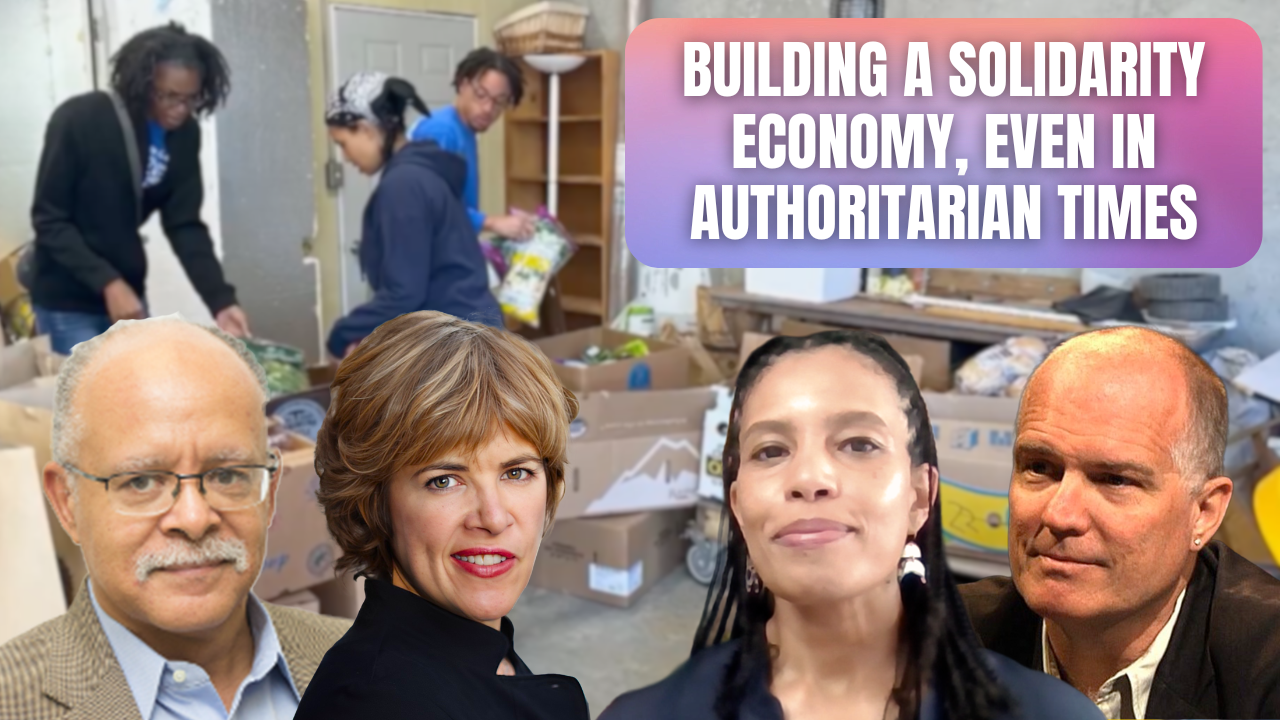
People across the country are resisting authoritarianism in creative and powerful ways, and this is just the start. The folks at The People’s Network for Land & Liberation (PNLL) say the forces that got us here are bigger than one bad leader; entire systems must be taken down. Building a brighter future requires a vision of economic and social justice — and lots of practice. Today on Laura Flanders & Friends, we look at some of those practical experiments and paths for radical change, and discuss why they’re just as important as resistance. The members of PNLL, a multiracial, multiethnic consortium of six community-based organizations, are doing politics and economics differently in real places across the U.S. right now. Joining us are Edget Betru, an attorney, activist and Coordinator of the People’s Network for Land & Liberation; David Cobb, PNLL staff person and Co-coordinator of the U.S. Solidarity Economy Network; and Blair Evans, Founder and Executive Director of Incite Focus, a production and training lab based in Idlewild, Michigan. Find out how to build for the future — even in the toughest circumstances. All that, plus a commentary from Laura on William Morris’s News From Nowhere.
“We’ve been colonized in our minds . . . Involving people in day-to-day produce, meeting their needs through a different way, through thinking, Hey, who in my neighborhood knows how to fix this? . . . It’s really that shift in consciousness that needs to happen that’s going to allow for this new economy to emerge.” – Edget Betru
“My mama and my mamaw and my papa who raised me taught me a lesson as a little boy, and that is, there’s enough to go around as long as we share. That made sense to me when I was five years old. It makes sense to me now when I’m 63 years old. There’s enough to go around as long as we share. It’s just as simple as that.” – David Cobb
“We can make things that make things, we can design and build our own equipment that can then use locally sourced materials, hyper localizing the supply chain . . . We can stop feeding the monster that’s consuming us and actually disconnect from that process and use what we have.” – Blair Evans
Guests
- Edget Betru: Coordinator, People’s Network for Land & Liberation; Board Member, Community Movement Builders
- David Cobb: Staff, People’s Network for Land & Liberation; Manager, Butterfly Impact Fund; Co-Coordinator, U.S. Solidarity Economy Network
- Blair Evans: Coalition Member, People’s Network for Land & Liberation; Founder & Executive Director, Incite Focus; Designer & Trainer, Fab Lab
Transcript
Show full transcript
LAURA FLANDERS & FRIENDS
THE PEOPLE’S NETWORK FOR LAND & LIBERATION: FINDING PRACTICAL PATHS TO ECONOMIC & SOCIAL JUSTICE
Watch| Download Podcast – Uncut Interview | Download Podcast – Episode
LAURA FLANDERS: Under an onslaught of cuts, militarization and the reversing of even this country’s slow moves towards economic and ecological common sense, it is hard to visualize a big, bright future for all right now. But talk to students of this moment and they’ll say that what we are going through isn’t a surprise, it’s the product of a system, and that’s not going to be solved by tweaks around the edges or even electing a new leader, but needs total overhaul if humane life on a functional planet is going to survive. If all that is true, then resistance to fascism is only part of what’s called for. The other part is vision, and not just pie in the sky imagining, but right here, right now experiments and practical pathways out of today’s status quo. The People’s Network for Land and Liberation, PNLL, was formed with exactly that agenda. The Network is a multi-racial, multi-ethnic consortium of six community-based organizations, each of which is doing politics and economics differently in real places across the US right now. What are they finding, and how are they doing it even in the midst of a crisis? That’s our question. Today we’re joined by guests from across the network. Edget Betru is an attorney, activist and Coordinator of the People’s Network for Land and Liberation. Betru is also a board member of Community Movement Builders, a member-based collective of Black people based in Atlanta, Georgia. David Cobb is a PNLL staff person and Co-coordinator of the U.S. Solidarity Economy Network. In 2004, he was the Green Party presidential nominee and served as the campaign manager for Jill Stein’s 2016 presidential run. Blair Evans is the Founder and Executive Director of Incite Focus, a production and training lab based in Idlewild, Michigan, a historically Black enclave and resort town once known as the “Black Eden.” Blair has designed and launched more than half a dozen Fab Lab centers. Those are MIT-backed initiatives that are bringing digital fabrication like 3D-printing and more to all sorts of people that our economy at present shuts out, and teaching them how to make different things better in a way that is better for all. All of which makes me incredibly glad to see all of you in this program. Thank you, and welcome to “Laura Flanders & Friends”. There are six members of this network, David, in vastly different places in different circumstances involving different and distinct sorts of people and practices. What’s the connecting tissue?
DAVID COBB: Well, the connecting tissue is an analysis specifically around a five-point program, which I’ll invite Edget to describe, but I want to take just one moment to underscore Cooperation Jackson in Jackson, Mississippi, the heart of the Neo-Confederacy. Then Community Movement Builders, which is a national chapter-based group, but Atlanta is their chapter headquarters. Then we go to Wellspring Cooperative in Western Massachusetts, which is literally half folks from Central and South America and half poor working class white folks. Then Cooperation Vermont in the Northeast Kingdom, 95% white and exclusively rural. Then cut across to Michigan, Black Eden. Then Native Roots Network in Western California in the far north coast, an Indigenous-led grouping of trans-tribal, multi-ethnic people. The point is this experiment is really six experiments at once united around a five-point program, and I’ll invite Edget to talk about what that five point program is.
LAURA FLANDERS: Edget.
EDGET BETRU: All right. So the PNLL five-point program aims to address really undermining the foundations of the current extractive capitalist system that is grounded in the control and ownership of the means of production, right? The private ownership of land, the exploitation of labor. And so our program and instead aims to de-commodify the land so that we have access for food production, for housing, for all of the things that the land provides, right? We have community production, which means everything from growing food to using traditional and modern digital technology to produce the things that we need. We are incubating and supporting the development of workers’ cooperatives so that we can learn how to work together to not only produce what we need, but engage in direct democracy so that we are making our own decisions about not only our work, what we’re making and how we use it in that community. And very importantly, we always incorporate education, because without the critical understanding of why we’re doing all of these things, it will be very easy to undermine all of our work. And finally, we incorporate art and culture in everything that we do, and that’s just from our ancestral knowledge and practices to creating the new and making it all beautiful.
LAURA FLANDERS: Beautifully laid out. I appreciate that. Coming to you, Blair, how would you describe what you are doing there at Idlewild and how it reflects those principles that Edget just outlined?
BLAIR EVANS: Well, first thing, all of the nodes are earnestly involved in integrating all of these pieces because without all of them, the whole process kind of falls apart. Idlewild is focusing a lot on anchoring the community production piece because we have people here that that’s an area of specific expertise. But we’re taking a lot of the historic resources that are in Idlewild and converting those into community land trusts operated by worker co-ops, also building community production center where we can actually have additional worker co-ops, and that’s collectively owned in terms of the lands and the co-ops, producing goods for use in the community by people, their families and community members, and also for exchange for those things that, you know, we would like to be able to purchase. Idlewild’s history has a lot to do with arts and culture, and so it’s a natural to be able to embed a lot of these principles and represent those in music festivals and the like that we that we have here. We also are building new systems, like we have a 60 acre campus, which will be a good anchor for community production here in this area. So our approach is a combination of the traditional and historic aspects of Idlewild, but also building what the next 100 years of Idlewild will be about at the same time.
LAURA FLANDERS: Let’s talk about what brought each of you to this work. Let’s start with you, Blair.
BLAIR EVANS: Well, I grew up in Detroit in a very active family and community. So, you know, between my church and the community organizing and the like, it was what you did. It wasn’t something I thought about because it was just part of the fabric of the universe when I was kind of growing up. Later on, a lot of that, you know, teaching about institution building and the necessity working within communities was just a natural part of things. I went off to do a lot of technical training, but always in the back of my mind was, how are these tools to be able to provide greater leverage to those efforts.
LAURA FLANDERS: Coming to you, David, why you? I mean you’ve got a history in Green Party activism, but this takes that to another level, it seems to me? Why did a little David Cobb perhaps find his way into this work today as it, at all?
DAVID COBB: Well, Laura, anybody who knows me, I’m a proud and unapologetic mama’s boy, and my mama and my mammaw and my pappaw who raised me taught me a lesson as a little boy, and that is, there’s enough to go around as long as we share. And for me, that made sense to me when I was five years old. It makes sense to me now when I’m 63 years old. There’s enough to go around as long as we share. It’s just as simple as that.
LAURA FLANDERS: And what about you, Edget? How did you get into this?
EDGET BETRU: I guess I’m a grandma’s girl. So my family’s from Ethiopia and I grew up in Ethiopia. My grandmother was just one of those people that was very involved in her community and we would feed once a month, we would feed anyone and everyone in the neighborhood who needed food. And then my family migrated to Tennessee. And in my mind coming to America was, you know, the land of milk and honey. Everybody was going to have everything, and I was shocked and horrified. My church went to deliver groceries and basic toiletries to people maybe an hour away from where we were living. And there were children there without shoes. There was, you know, still people who didn’t have real indoor plumbing, and this was white and Black communities. From that point on, I realized that there were those who have and those who have not, and there were a lot more people who did not have than who had. And I just, you know, I was always committed to doing my part to change that.
LAURA FLANDERS: I’d love you, David, to talk about not just the network and how it operates, but one of the sort of ecosystem projects that you are very involved in, which has to do with agriculture in the Massachusetts area.
DAVID COBB: In Wellspring, the third-largest indoor greenhouse in the State of Massachusetts is operated as a worker-owned cooperative by the Wellspring Cooperative. One of about 10 co-ops, an already existing network of co-ops that are showing that we can meet our needs for food, housing, everything at once.
LAURA FLANDERS: Coming to you, Blair, you have talked about how your projects speak to many problems at once, and also how they alleviate many of those problems at once. Can you explain how it works and also how you see Digital Fabrication as changing some equations here?
BLAIR EVANS: We’re in a period of acceleration into these kind of polycrises, but we’re also in a period of exponential explosion and capabilities in a lot of technologies. One of the key aspects with digital fabrication, which is moving forward very rapidly, is the ability to flexibly use what you have to produce what you need. And so that means being able to refashion, add value to things. It doesn’t have to be commodity, global supply chain, uniform materials that go through a huge capital-intensive factory process. We can make things that make things. We can design and build our own equipment that can then use locally-sourced materials, hyper-localizing the supply chain to then to produce the things that we need. By becoming familiar with what a couple generations ago was normal, which is using what’s in your environment to create what you need, we’ve been so disconnected from that, that reconnecting with that just helps us become better people and more full. But again, being able to kind of understand how we can stop feeding the monster that’s consuming us and actually disconnect from that process and use what we have.
LAURA FLANDERS: What sort of things are you making right now there in the Digital Fabrication labs?
BLAIR EVANS: In Idlewild area, one of the things that is a dominant focus for us is housing. Actually producing housing that has low total cost of ownership, very energy-efficient, and allows flexibility as we used to generations ago, to be able to kind of modify and expand things as family circumstances grow and change. So a person doesn’t have to go from a starter house and then move to another community when you have kids and then move to another community when you’re an empty nester, but actually maintain your social connections and have the physical environment adaptable enough so that you can stay put and continue to move forward and not have to go through the economic or social trauma.
LAURA FLANDERS: You are pulling a lot together there in Atlanta, Georgia, Edget, at Community Movement Builders. For people that don’t know about you, what can you tell us? Some may have heard of and seen reporting on this program about the Stop Cop City Movement, but they probably don’t know about your work with cooperatives, including, did I read a sea moss cooperative and an aquaponics project?
EDGET BETRU: Yes. Yes.
LAURA FLANDERS: So what does that look like in practice?
EDGET BETRU: It’s a project where we have workers who actually process the sea moss, package it. We are calling–
LAURA FLANDERS: Wait a minute, wait, just roll back a minute. You are growing sea moss in Georgia?
EDGET BETRU: We’re not growing it, we are not growing it. We have allied communities who are also cooperatives in Belize and St. Lucia. And we, so we source the sea moss from there, but it is here in Atlanta where it’s cleaned, processed, packaged, marketed and distributed, right? And that’s really where we’re trying to get all of our nodes and all of these cooperatives to get to a place where we have full supply value chains that are outside of this extractive system, that are providing decent jobs for our community, but also producing things that we can actually consume and nourish us.
LAURA FLANDERS: What do we do with sea moss?
EDGET BETRU: You take it. It’s a supplement. So it’s a nutritional supplement, and it has all the minerals and vitamins you could ever, you know, want. And I’m glad also that you brought in our work around Cop City because it’s the model for our organization. We fight the institutions that are in our communities that are not serving us, and instead we build ones that we are controlling. So that means, for us, it includes a school, a full-time school called the Malcolm X Academy in Sacramento. It means an afterschool program in Dallas. It means a farm where we’re actually growing food and we have a food program where we distribute groceries to the community.
LAURA FLANDERS: When we met there in Idlewild, Blair, you were on your way to visit another member of the network, Native Roots.
BLAIR EVANS: Native Roots Network has a history of using what’s in the environment in ways that allow them to produce things that are useful and important to them. And so it’s a matter of just adding a tool to the toolkit and not changing a whole philosophical perspective on how one ought to live life. They have a significant amount of land that they’ve been able to recapture partly in collaboration with PNLL, and are looking at how to use the things that can be grown and sustainably extracted from the land to create the durable goods that they need along the way. So that’s a wonderful collaboration between the historical knowledge that you are part of a place and you can use the things in a place and then adding tools and some other people, you know, can leverage that in a different way and just learn what that philosophy is about to be able to pivot.
LAURA FLANDERS: David, coming back to you, I think people are probably getting very excited and enthused and feeling encouraged by everything everyone is saying, but this work isn’t easy and it’s not happening in a vacuum and we are in very tough times. So how do you find people’s receptiveness to these ideas at a time when many might be thinking, as you said earlier or someone did, I just want to get through today?
DAVID COBB: Well, Laura, look at here. My daddy was a junk man and he taught me something very valuable, and that is, it is very easy to sell a drowning person a live preserver. And more and more people are coming to awareness that the ecological collapse is accelerating, that the promise of how America is supposed to operate was always a lie. It was always racist, sexist and class-oppressive. So we are finding that more and more people are eager to learn from us just as we are learning from them. We are not just build up the People’s Network for love and deliberation, but propagate out these ideas, because we’ll know that we’re successful when we have supplanted the extractive power over dominated capitalist system and moved into an ecologically sustainable, racially and socially just society. We’re playing for all the marbles, Laura.
LAURA FLANDERS: All right, I like it. Edget, coming to you, the story that you are all telling so beautifully and cooperatively, if I might say so, reminds me a lot of what I found on a visit to the Mondragon Cooperatives in the Basque Region of Spain many years ago, and people can find that episode in our archives. What I was reminded of there was that that model also, which grew to create some of the biggest co-ops, biggest companies in Spain, grew out of fascism, a fascist moment. How do you square this forward-looking work with the resistance to this fascist moment in your work and as you look around?
EDGET BETRU: I think the folks that are doing this, what we would call mutual aid type work, coming together to collectively meet our needs, also understand that sometimes that means we have to protect the work that we’re doing. We have to protect each other. And we are, right now, we’re witnessing brilliant examples of that in Minneapolis, in Chicago, in Los Angeles, you know, and in communities throughout the country. I think the benefit of a network like the People’s Network for Land and Liberation is that we can support each other. We learn from each other, we share resources. And you know, when that is multiplied and expanded all across the country, all across the globe, there’s nothing that can stop that. There’s more of us and there is them.
LAURA FLANDERS: What are some of the biggest challenges, Edget, as you do this work?
EDGET BETRU: We’ve been colonized in our minds, not just, you know, externally, but in our minds, when when something breaks or I need something, I think, do I have money to be able to go buy something new? Right? And so this involving people in day-to-day produce, meeting their needs through a different way, through thinking, Hey, who in my neighborhood knows how to fix this? What about the library, the lending center that the community production center has for tools? Maybe I could go get that. It’s really that shift in consciousness that I think needs to happen that’s going to allow for this new economy to emerge.
LAURA FLANDERS: David, coming to you, this is all fine and good, but usually there’s a point at which money is involved. How are these projects actually funded?
DAVID COBB: All of our nodes are champions at grassroots fundraising and traditional philanthropy. Like each of the six nodes are already basically quality, star community-based organizations. But the People’s Network for Land and Liberation has also come together to create something unique. We’re calling it the Butterfly Impact Fund. It is a explicitly post-capitalist impact investing fund that we go to people of wealth and say, “Hey! If you’re looking for market rate returns on Wall Street, we not your folk. But if you are interested in a transformational approach, let us show you with objective metrics that show how many people we’re feeding, how many people we’re clothing, how many people we’re employing, actually show you a path forward and you will take much lower rates of return.” What we call regenerative return and instead of the market rate returns.
LAURA FLANDERS: And how’s it going so far, dare I ask?
DAVID COBB: Well, I got to say we’re raising millions of dollars already and well our plan is to raise and deploy between 10, 50, 100 million in the next decade, all with the explicit purpose of dismantling this racist, sexist, and class-oppressive society and creating a regenerative power with society where goods and services are being produced and distributed in fair, ecologically sustainable ways.
LAURA FLANDERS: David, you’ve brought me to a place of sort of imagining a future. Do you have a picture of it in your mind, Blair?
BLAIR EVANS: It’s going back to villages with some high tech kind of support, right? So we’re not dealing with these very, very, very fragile, highly vertical systems. We’re dealing with people who know how to use what’s in the areas that they’re dealing with to provide for their needs, and there may be specializations that you exchange back and forth, but you’re not being held hostage for your basic needs of life through, you know, supply chains that you don’t control. So I guess what I see it as are groups of people who are living together in a more coherent and cohesive way that are collaborating with other groups that are doing the same thing on a more network-distributed horizontal basis rather than this highly vertical basis.
LAURA FLANDERS: David, what about you? What’s the future your heart’s longing for?
DAVID COBB: It is a return to the ecologically-balanced world that existed before empire, before settler colonialism, before white supremacy, before capitalism. Laura, this is our birthright. We are supposed to be living in a way where we are stewarding mother earth and she is succoring us. That’s how we’re supposed to live, and the People’s Network For Land and Liberation is proving that we can do it right here, right now.
LAURA FLANDERS: What about you, Edget? Is it about returning in your mind?
EDGET BETRU: I think it’s a combination of returning and embracing the best of our past with the creation of the new, so that we can have flowers and clean streams and time to enjoy them and time to enjoy each other.
LAURA FLANDERS: Oh, love it. What a great place to end. I thank you all for your work and for spending this time with “Laura Flanders & Friends”.
EDGET BETRU: Thank you.
LAURA FLANDERS: Poet, essayist, craftsman, designer William Morris lived in a time quite like ours. At the end of the 19th century, the world was getting richer, thanks to new technology and new means of control, but those riches were captured by the wealthy few with the rest left to either compete or comply or complain. Morris knew the complainers from his socialist meetings. He read their diatribes and debates in magazines, but in 1890, he published not another diatribe, but a diary of a dream, of a dream of a man like himself who wakes off to one of those meetings to find himself in a future version of his land. It’s just recognizable, but there are no prisons, no factories, no old-style schools. The land is healthy and the people happy and beautiful. Morris spends as much time describing how it feels and tastes to live in those times in that way then as he does describing how they get to where they’ve come. In so doing, he’s saying there is power in a feeling. And I wonder if we consider the power and the feeling of a win, of registering someone to vote against the odds, of banning fracking or freeing someone from prison. How does it feel to be singing with others outside an ICE detention center? And what’s the power in that feeling, in that taste of possible futures when stacked up against the noise of the naysayers, the ones who say it can’t be done? I’ll leave you with that question. And if you want to find my full uncut conversation with today’s guests who are doing more than dreaming, you can through subscribing to our free podcast or our newsletter or my Substack. All the information’s at the website. Till the next time, stay kind, stay curious. For “Laura Flanders & Friends”, I’m Laura. Thanks for joining us.
For more on this episode and other forward-thinking content, subscribe to our free newsletter for updates, my commentaries and our full uncut conversations. We also have a podcast. It’s all at lauraflanders.org.
Related Episodes, Articles, Uncut Conversations and More
Follow Laura Flanders & Friends on Patreon to receive our Show Notes every week and the full, uncut conversation from each episode. And check out our New Economy playlist on YouTube.
Full, Uncut Interview
*Recommended book:
“Beautiful Solutions: A Toolbox for Liberation”, Learn More Here*
(*Bookshop is an online bookstore with a mission to financially support local, independent bookstores. The LF Show is an affiliate of bookshop.org and will receive a small commission if you click through and make a purchase.)
Related Laura Flanders Show Episodes:
• Jackson Rising: Creating the Mondragon of the South: Watch
• Resisting Trump & Authoritarianism: The “Beautiful Solutions” Toolbox: Watch / Listen
• Community Wealth Building: An Economic Reset: Watch / Listen: Full Uncut Conversation and Episode Cut
Related Articles and Resources:
• Community Movement Builders’ Community Sea Moss Cooperative
• Tale of the Tape: An Expert Weighs In on the ‘Cop City’ Bodycam Footage, by Madeline Thigpen, February 15, 2023, Capital B
• Cooperation Jackson, The Build and Fight Educational Series
• Cooperation Vermont, Seeding the Alternatives for the Future
• Cooperation Vermont Buys Former Rainbow Sweets Building, by Paul Fixx, February 4, 2025, The Hardwick Gazette
• Incite Focus, where ideas and imagination meet inspiration and innovation
•. Native Roots Network, Acornomics, Land Restoration, Workforce Development
• Community Land Trusts, April 11, 2023, Nonprofit Quarterly
• Cooperatives, April 12, 2023, Nonprofit Quarterly
•. Food Sovereignty, Nonprofit Quarterly
• Wellspring Cooperative, building a just and sustainable economy, one co-op at a time
• U.S. Solidarity Economy Network (US SEN)
• Move to Amend: End Corporate Rule. Legalize Democracy
Accessibility
Laura Flanders & Friends is committed to making our programming, website and social media as accessible as possible to everyone, including those with visual, hearing, cognitive and motor impairments. We’re constantly working towards improving the accessibility of our content to ensure we provide equal access to all. If you would like to request accessibility-related assistance, report any accessibility problems, or request any information in accessible alternative formats, please contact us.