Prefer to Listen?
Subscribe to our podcast to listen to this week’s episode on your favorite podcast platform (Available 1/21/26).
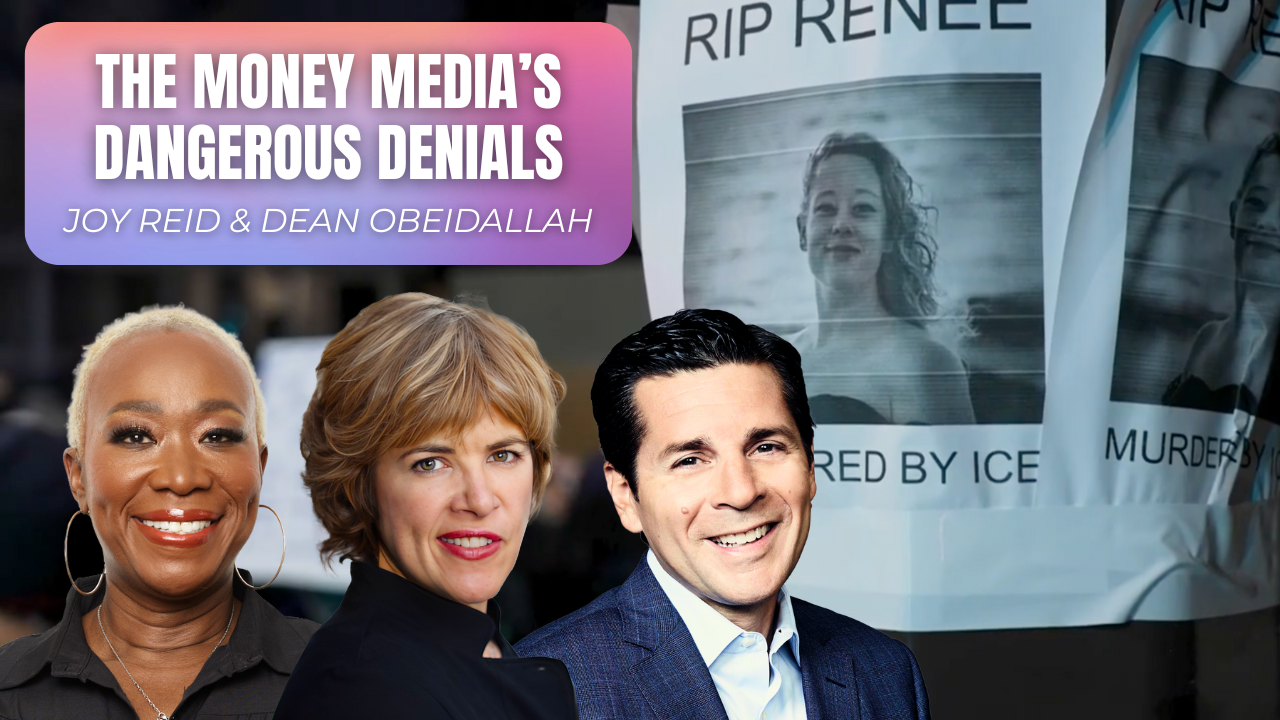
Journalism is at an inflection point. Under a hail of lawsuits, firings, new hires, and mercenary mergers, the business of media is in shambles even as the need for reliable, truthful information to reach voters is greater than ever. Where does that leave journalists? In this episode, Laura and her guests discuss the money media’s dangerous denials and obfuscations, the problem with bothsidesism in a time of fascism, and the coverage of Renee Good’s killing in Minneapolis. Dean Obeidallah is a lawyer, writer, award-winning comedian and host of SiriusXM radio’s national daily program “The Dean Obeidallah Show”. Joy Reid, formerly host of the award-winning ReidOut on MSNBC, is a best-selling author, and host of the Joy Reid Show on YouTube. The decline of legacy media isn’t all bad news — especially for those, like Palestinians and others, who were always shut out of it — and the rise of independent platforms, savvy media consumers and new mechanisms for collaboration just might usher in a new age of great journalism, just when we need it. Join Dean, Joy and Laura for this rich conversation on resistance, reporting, and survival.
Guests
- Dean Obeidallah: Host of SiriusXM radio’s The Dean Obeidallah Show
- Joy Reid: Host of The Joy Reid Show
Transcript
Show full transcript
LAURA FLANDERS & FRIENDS
JOY REID & DEAN OBEIDALLAH: WILL JOURNALISTS CHOOSE TO SAVE OR SINK DEMOCRACY?
Watch | Download Podcast – Uncut Interview | Download Podcast – Episode
NIKKI GLASER: And the award for most editing goes to CBS News. Yes. CBS News, America’s newest place to see BS news.
LAURA FLANDERS: Journalism is at an inflection point. What you just saw was Nikki Glaser’s monologue at this year’s Golden Globes, literally calling CBS a purveyor of excrement after that network shelved a “60 Minutes” report on torture in ICE detention at the behest of its new editor in chief. CBS is now an official laughing stock, and that’s just one example. Under a hail of lawsuits, firings, new hires, and mercenary mergers, so-called mainstream media is in shambles. And then there’s the morass that is the social media world. So, where does all of this leave journalists? If democracy continues to depend on voters being able to know what’s going on and tell truth from flat out lies, the journalists’ job is as important as ever, but massively changed. So how? How different? How hard? How bizarre? Today, two guests who embody both the doggedness and often the delight in doing journalism differently in this wildly chaotic, deadly, dangerous time. Dean Obeidallah is a writer, lawyer, award-winning comedian, and host of Sirius XM Radio’s national daily program “The Dean Obeidallah Show.” Joy Reid is a bestselling American author, journalist, and host of “The Joy Reid Show,” formerly national correspondent for MSNBC, now MS NOW, and host of the Emmy-nominated, two-time NAACP Award-winning nightly program, “The ReidOut”. Whoo! That is all a huge mouthful because of how much changes all the time. But Joy and Dean, thank you for joining me, friends here on “Laura Flanders & Friends.” Just to bring us into this moment, I would start with, you know, what’s on the top of your mind and your heart as we begin this conversation? Dean.
DEAN OBEIDALLAH: It has to do with the ICE officer killing Renee Good. And the response of this administration is unlike anything I’ve seen. Laura, there was not even any hint of compassion that an American had been killed. They began calling her a terrorist within hours. Something that you would expect to see maybe in a Middle East regime when they’re killing protestors, calling them terrorists or foreign agitators. It was happening in America. Zero compassion, zero empathy. Kristi Noem out there saying she’s a domestic terrorist. And then doubling down, JD Vance having a press conference, saying it was an attack on America. And we’ve not seen that. And now what’s the response of the Trump administration? To send more troops. Like the Iraq War surge, now there’s surging in Minnesota, because, on some level, and I’ve been saying this for over a year on my show, we’re at war.
LAURA FLANDERS: Joy, what about you?
JOY REID: Yeah, I mean much the same. I mean, if everything that’s happening in the United States was happening, let’s say, in my father’s country, in the Democratic Republic of Congo, we would be saying that this represented a regime that has essentially done a coup against democracy. Think about the terminology we would use if this were a foreign country. And yet the media, the mainstream media, as much as it has somewhat progressed toward calling what Donald Trump and his regime are doing by the real true words that the dictionary would imply, they’re getting there, but they’re still not able to see this as a fundamentally undemocratic regime. The thing that I will note is that the killing of Renee Good represents an escalation that I think is significant in that she is a white woman. And had this been a Black woman, a Muslim, had it been an Afghan refugee or something of that nature, I’m not sure that the reaction would be the same. I think people would still be outraged. But I think for white Americans, seeing this woman murdered in broad daylight in a suburban neighborhood in front of her neighbors, including a doctor, it changes the stakes, I think, for white America in the same way that the George Floyd murder, not far from that Minneapolis neighborhood, changed the stakes on Black Lives Matter for everyone, where people were forced to reckon with what police could really do. Now I’m interested in watching what white America is doing with the information that white women are now also on the table and open to being victimized by the state as well and by state violence. I think that is game-changing. She is the George Floyd of this stop ICE movement, even though she’s not demographically what the targets of ICE really look like.
LAURA FLANDERS: It was also important, although in some ways regrettable, that the first story that most mainstream America got of what had happened there was of this blonde, beautiful white woman. We didn’t know yet that she was a lesbian or an activist or any of those things. There are so many layers, so many what our friend Kim Crenshaw would call intersections in all of this. In the context of this, I talked about journalists at the top. What do you perceive your role to be in these times? Reporter, commentator, opinion maker, activist, what? Joy.
JOY REID: I’ve always been an opinion journalist ever since I got out of local news. I wrote an editorial for the Miami Herald opposing the Iraq War, almost got fired for it, and wound up leaving because the way that the media was covering the run-up to the Iraq war and the invasion, I found distasteful. And I thought, I’m done with media. So when I came back into media, I came back in as an opinion journalist. And I see my role now as as an advocate, because I do believe that when you’re facing autocracy and authoritarianism, the role of the media is to be part of the resistance. And I know that that makes a lot of journalists cringe because they don’t want to be in conflict with the administration, but to me, we are not in normal times. This is not politics, it’s autocracy. And so I see myself as a fellow truth teller trying to illuminate what the regime is doing so that people can see what’s happening to them and understand it in very real and stark terms.
LAURA FLANDERS: And what about you, Dean? What’s been your kind of trajectory into the work you’re doing now?
DEAN OBEIDALLAH: All of my work through the years of comedy for 20 years has been as an activist. You know, I was doing comedy to make people laugh but try to break down stereotypes about Arab Americans and Muslim Americans. I’m still producing, it’s our 23rd year of the New York Arab-American Comedy Festival this fall. We’re still breaking down the stereotypes. So my journalism work, if you want to call that, is opinion-based but the same idea. Trying to effectuate change, trying to be an activist. I am delusional. I believe I can change the world. I think we all are delusional like that or we wouldn’t be doing this. And can we really change it a lot? Maybe, but little bits. I really believe each of us can play a role. And that’s why I feel like I’ve been trying to push things a little bit and bring others along who agree with my opinions and our views.
LAURA FLANDERS: I would love your sense of what do you think is the most grievous thing that mainstream, so-called, corporate money media are doing or failing to do? You’ve alluded to some of it. And then I want to talk about some of the freedom, perhaps, that you and we have being outside of those structures. Joy, what do you think is the fundamental biggest thing you’d like to fix right now?
JOY REID: Well, I think that going back to when Trump first came in, the media would not use the word lie. And there was a big struggle. I was working in corporate media at the time. There was a big internal struggle about whether you could call an untruth a misstatement, whether you could just say it was a lie. That was a stupid fight, right? And there have been a lot of those kinds of stupid fights, where the media has been so reluctant to be in conflict with any administration. Not just Trump, with Bush, with, well, Obama, they didn’t care, because that was the Dems. If it’s a Democrat, they don’t mind being in conflict. But when it’s a Republican, because the media is so afraid of what Roger Ailes did, which is to present this notion that the media is biased against white conservatives. And now they’ve committed an even further crime, which is to become co-opted by the same oligarchs who directly benefit from the regime. They’ve now bought up most of the administration, including CBS. I just want to read this very quick thing to you. The Times is reporting that Bari Weiss, who is the podcaster or Substacker, who, for whatever reason, is now in charge of the Tiffany Network, CBS News, she sent a note to her staff before Tony Dokoupil’s launch as anchor of the “CBS Evening News,” which, a job he got because he called Ta-Nehisi Coates a terrorist. And that angered Zionist, pro-Zionist people. And so his reward for calling Ta-Nehisi Coates, the brilliant writer, a terrorist, was to get the evening news, I believe, that’s my opinion. I’m an opinion journalist. She said, “Let’s make sure every single night has something with viral potential. The goal for this road show”, of Tony Dokoupil’s, “is not to deliver the news so much as it is to drive the news. We need to be the news for these 10 days.” It is a crime against journalism for the editorial director of a news network to say, “Our job is not to deliver the news but to go viral.” That’s crazy.
LAURA FLANDERS: That’s the commercial interest, the commercial mode of playing itself out and saying the quiet stuff out loud. Again, Dean, if you had to change one thing, what would it be?
DEAN OBEIDALLAH: I will say this, I think we are all, more journalists, in the realm and in the form of Edward R. Murrow than they are, because Edward R. Murrow famously said, “There are not two sides to every issue.” Like, there are not. There are not two sides to the Klan. I remember a cable news network, and I won’t say which one it is, said to me, during Trump’s first term, they wanted me on to talk about Trump’s anti-Muslim bigotry. And I said, “Okay.” And they said, “We just need someone from the other side.” I go, “Someone who’s pro-anti-Muslim bigotry?” And the producer just, like, stopped talking. He’s like, “Oh, we’ll get back.” And then they just killed the segment, because they couldn’t, in their mind, do a segment where it wasn’t two sides. There are not two sides, and we know this, there are not two sides to a lie, there’s not two sides to Trump’s fascism. I would go on Joy’s show, and me and Joy would say “fascism.” And Mehdi Hasan and all the other people there, “What are you doing? How outlandish.” And so, I mean, we’re at the point where I’m literally quoting Hannah Arendt and the banality of evil to explain to people what ICE is doing, and that’s not over the top. I am not even close to over the top. And so what I would like corporate media to understand, their job is not to make money for shareholders and executives to get bonuses but serve the people, make them smarter, even if it means losing access. I know that’s a lot to ask. But that’s what I would like, because an educated, informed electorate is the key to saving this republic.
LAURA FLANDERS: The problems that you’ve both just described go back so far. I mean, really, to sort of Spiro Agnew managing to create this bugaboo of the, quote, unquote, “liberal media” that put all the media organizations on the back foot, bending over as far backwards as any yogi could possibly manage. And then everything that we’ve seen since in terms of commercialization of even the news. The crisis, so-called, in legacy media is real, but it has opened up some incredible opportunities, and you both have seized them, as have I. Talk about the sort of pros and cons of this moment, Dean.
DEAN OBEIDALLAH: Look, if there was ever a time for corporate media to implode, thankfully, it’s now on the ascendancy of independent media, because years ago, if they still controlled all the ways to get information out, we’d be dead. I mean, like, they would be just all gatekeeping and just doing pro-Trump, pro-regime propaganda, and we would not be able to get our message out there. So look, I mean, technically, I work at SiriusXM, which is a big corporation for sure, but I don’t think they even know I’m there. Like, it’s really, like, there’s no executives that even talk. No, I do meet with an executive, but it’s never about the content and stuff. It’s like, do your thing. Unless I get a complaint about something, and it’s rare, we’re just doing our thing. So we have the freedom of independent journalism. Also, I write for Substack, where it truly is independent. I don’t have to pitch anymore to editors, who I liked, and they were great, and wait for a day and then change it and then dilute what I wanted to say. I think we have more freedom. We’re also building allies in the independent media world. Laura, you were the first independent media person I met. I’m not kidding, you and probably Amy Goodman. Right, so now there’s so many! There’s too many! There’s all these young guys, have a million followers on TikTok. How did they get that? They’re like 26. But the point is, like, there’s so many more of us, so I’m more confident, the future is brighter, that we can get our message out.
LAURA FLANDERS: Well, but what about that, Joy Ann? I mean, there is a huge morass out there. How do you keep your head above water, get your head above the parapet, as it were?
JOY REID: I go back to two things, I’ll give two examples. I wrote this book about Medgar Evers and Myrlie Evers-Williams. You know, Medgar Evers, one of the jobs he had was he was a journalist. He actually started a newspaper because they couldn’t get real news out of Mississippi into rural communities, where they were just being lied to about civil rights, lied to about the NAACP. So he and a white woman, her name was Hazel Brannon Smith. She was pretty amazing, she actually was an award-winning journalist, and she had a press of her own, but she decided to lend the press to Medgar Evers. She was shunned by white society. She was disinvited from the white community. And what she did in response? She had all the Blacks over tea. She said, “All right, you all, come on. I got nobody to have tea and hang with me. You all come on to my house, and let’s do this.” That is the kind of underground radical advocacy journalism that was needed to fight Mississippi fascism. And if you go to Russia, I think of Alexei Navalny, who was also using outside of the very closed system of Russian media to get information to younger people through the internet and through all these alternative means. Unfortunately, he died for it, but that is true activism and true heroism. So I think that the great thing about this moment and not having to answer to a corporate sort of overseer is that we can get on the ground. We can get on the ground like Medgar. We can get on the ground and try to fight this fascism that’s overrunning our country at a rapid rate. They had a plan, Project 2025. We didn’t have a plan, but we have huge community. We have the MeidasTouches of the world. We work together, we work as a system, we’re like an amoeba. You know, so, it’s harder to stop us because there’s so many of us, and we’re working in tandem.
LAURA FLANDERS: Dean, I will say, you know, not only were you one of the first out there giving, you know, comedians telling news that we weren’t hearing elsewhere, you have brought caring about people in Palestine to our airwaves and to our pages long before there was much, just putting it mildly. Have you seen that story change in its coverage? And are you seeing connections made? Because, gee, when I saw that shooting in Minnesota, in Minneapolis, of Renee Good, I had just seen the incredibly extraordinary independent film, “The Voice of Hind Rajab,” and I’m thinking, when are we going to see the film about Nicole Good? That’s going to be the next one we see about an intentional killing.
DEAN OBEIDALLAH: I think things have changed. I remember going on Joy’s show years ago, Joy, and you might not remember, saying this, it was like in our morning show, and I talked about Palestine, and she says, “Thanks for coming on, because few people want to come on and talk about being Palestinian or the Palestinian experience or what’s going on or advocating for Palestinians.” I’m half-Palestinian. I just, it was part of my life. It wasn’t a political choice, it was a real-life choice. My family lives in the West Bank. I will say, Laura, years ago, there were a handful of voices out there in the media talking about it, like Rula Jebreal, our good friend, and a few others. There were some others who were really, really good. Now we have more allies than ever and the use of entertainment media. I think things have changed. I think younger people are amazingly interested. I think the horrific genocide in Gaza woke people up to something they had never seen before. There’s some allies that make me uncomfortable. I’m glad they’re saying the right thing. I don’t agree with them on anything else, but it’s become a humanitarian concern. And I wish my late father was here to see all the support for Palestine, because he never saw it in his life in America.
LAURA FLANDERS: Joy, coming back to you for a second, and you talked beautifully a minute ago about people taking risks. One of the things we hear from people in so-called mainstream media is they’re afraid to lose their access. You can probably imagine what many of them are going through in the way of kind of oversight and, you know, review processes and threats and fears. Do you have a message to them, or do you have any conclusions from your experience there about when or when isn’t it good to stay?
JOY REID: I’ve always said that you have to do within your comfort level what you feel called to do in this moment. You don’t want to look back and say you did nothing, right? But people have various comfort levels in terms of their risk tolerance. You know, I had a very high risk tolerance. There were hardly any Palestinians you ever saw. Ayman Mohyeldin was one, and Dean was kind of the other one. Rula, we used to get pushback. We would put her on, and we would, you know, I don’t think the artist formerly known as MSNBC was super comfortable with Rula, because we would get sort of pushback about her. So to me, I would say, to your level of comfort you should try to speak out. But do it, if you’ve got a mortgage and four kids and you got to pay for it, don’t throw yourself out. I was willing to take the risk. I’m confident, I’m a writer. You know, my husband and I have a production company. I’m like, I’m going to land on my feet. I’m going to take the risk. I’m going to book Rula. I’m going to book people who can speak about Palestine. I’m going to do it even though people was like, “Please don’t get fired, please don’t do it.” But I’m like, “No, but what’s the point of having?” It’s something Ta-Nehisi Coates said to me at a party. We were at a party, we were having this conversation about the risks that each of us were taking talking about Palestine. We were like, but then what’s the point of having a platform?
LAURA FLANDERS: Dean, coming to you. We interviewed journalists not so long ago on this program who were investigative reporters who were covering the rise of the Right and experiencing extraordinary personal attack. They were all super brave and said that what they were doing was important enough to take the risks that they were taking. They took sort of regular measures to defend themselves and encouraged others to do that too. But what should journalists, and especially citizen-type journalists who don’t have huge institutions behind them, know about the law, as a lawyer, about their First Amendment rights?
DEAN OBEIDALLAH: They’re not going to silence us, this and you’ve got to step up. You have to be comfortable with it. Being half-Sicilian probably gives me more, the idea of, like, we’re going to take the fight to ’em, more than the Palestinian side. People don’t get it. My Palestinian side, it tempers my Sicilian side. If I was 100% Sicilian-
LAURA FLANDERS: God, all you need is a little Irish, and you’d really have it made.
DEAN OBEIDALLAH: Right.
LAURA FLANDERS: Right?
DEAN OBEIDALLAH: If I was 100% Sicilian, there’d be a lot of baseball bats and arrest warrants in my life, okay? The Palestinian side goes, be strategic. And even to Joy’s point, I used to go on her show, and they were okay with what I said because I had to be aware of what I was saying. I knew that if I go too far and say too many conclusory terms, then it can mean you’re not getting on again. So my whole approach all the time was, don’t use the conclusion, don’t say apartheid, let’s say. Say what the real life is for my family. Let people draw their own conclusion. So I was very aware on Joy’s show of walking on the edge and being aware of what I was saying very, very carefully so that I could go back on so that a Palestinian voice could still remain in the media. That was very important to me.
LAURA FLANDERS: I think questions are always helpful, too, provoking questions. And you provoked, well, you kind of concluded but you kind of provoked, Joy, when you said, you know, that Nicole Good, Renee Nicole Good, is the, you know, George Floyd of this movement, this moment. I thought, hmm, I bet she gets pushback from some people about that. And I wondered whether you were able to have a conversation in your space, with your audience, that was more complex than you might’ve been able to have on MSNBC, because on MSNBC, I would imagine you would have needed to be, you know, still policing the barriers of sameness in a white supremacist kind of society. Everything isn’t just George Floyd.
JOY REID: The point I was making about Renee Good is not really a racialized point, because she is not the demographic of people who are normally targeted by ICE, it is Latinos overwhelmingly and Black immigrants secondarily, but mainly Latinos were being targeted. She is white, she is not targeted. But the thing that I think makes her a George-Floyd-type figure is that movements are built on stories, as both of you know. And George Floyd, while people were home, stuck at home, staying away from their grandparents during COVID, everyone is watching this man die for 9 minutes and 29 seconds, be killed in public with cameras rolling and with an officer who felt impunity to kill him with three other officers standing and helping him. That was the narrative of George Floyd that had white people going, “Oh, wait, Black people are not being over the top when they say the cops are just killing them without, willy-nilly, without a second thought.”
LAURA FLANDERS: With their hands in their pockets, right.
JOY REID: With their hands in their pockets. But what’s happened with Renee Good is that, no, she’s not the demographic, but she shows the impunity. And I think because of that, her story, her kids, her wife sobbing by the side of the road, the fact that you hear her last words, “I’m not mad at you, man,” that’s her last words. The fact that she’s dancing in her car joyfully, trying to stand up for Black and Brown people. She is very much like the woman who was killed at Charlottesville, who, unfortunately, the democratic side, the small-D democracy side, did not lift up her story in that way. But they know Renee Good’s name. Everyone knows her name. And if the pro-democracy side is smart, they will make her the George Floyd of this movement, because stories, a narrative, a face. That iconic picture of her, much like the Trayvon Martin photo, which became the iconic picture, this beautiful boy with his hoodie, the black-and-white photo that his parents had to, like, trademark so people wouldn’t steal it because it was so beautiful and so iconic, we got a photo of that of her. And we need to wrap our arms around this woman, who is the absolute visual image of ICE impunity, that even will not respect the people that ICE was supposed to be designed to protect, White Christian moms.
DEAN OBEIDALLAH: It’s a war Trump has declared on us. It’s only certain Democrats who don’t get it, but MAGA knows they’re at war. Trump doesn’t want to govern, he wants to rule us. And this is a manifestation of this, it’s where we are. So, my heart is heavy for her family, for the fact that they won’t investigate the killer. But they want to prosecute the widow? Something out of, like, Joseph Stalin’s playbook. That’s what we’re living through right now.
LAURA FLANDERS: So let’s get to that final question. You’re both storytellers, the story that you think the future will tell of now. Take your pick, 25, 50, 100 years, what do you think is the story the future will tell of now, Joy?
JOY REID: I would say that, sadly, if people look back on this country 50 years from now, they’ll say that an experiment that began as a slave colony and lasted for 250 years, struggling to become a multiracial democracy, chose to dismantle itself over an election. Donald Trump may not have meant to, but he has ended the American empire. The only question now is, will he end our democracy as well?
DEAN OBEIDALLAH: It depends who controls everything in 20 years. But, you know, and if it’s the side of fascism, they’ll write about this being the glory days. This is a day where America became great again. And the same way if, you know, the Nazis would’ve survived and written 20 or 30 years later. But I think this is the real moment for us living in to think about that. And is it going to be on our watch that we’ve lost this democratic republic? So many people have sacrificed for us to have these freedoms that we take for granted. Are people going to step up? And, you know, before, generations before had to go over the ocean to fight fascists. All we have to do is stay engaged here. We don’t even have to risk our lives. Although some have, like Renee Good. So it’s up to us. I’m fearful of what it might be in 20 years, but I’m worried about November, this election. I mean, so, like, I think, so much, this November, Laura, you can quote me, is our Battle of Gettysburg. I think I’ve said this to Joy before. It’s our Battle of Gettysburg. If we lose this election, the midterm, the Confederate states are back in control of this nation. If we win, it’s the beginning of pushing the battle down and hopefully regaining our democracy.
JOY REID: Agreed.
LAURA FLANDERS: Well, no matter what the story is 25 or 50 years from now, it will include that there were dissenters and there were brave folks telling an independent story and doing their best to fire up resistance, and you two are definitely part of it. I’d like to believe the story ends up with a cheerier ending, but I’ll leave your thoughts where they are. It’s really been a pleasure being on with you. I wish you both the absolute best luck in your work and in your lives. And let’s convene again sometime.
JOY REID: Thank you.
DEAN OBEIDALLAH: Thanks, Laura. Great seeing you.
For more on this episode and other forward-thinking content, subscribe to our free newsletter for updates, my commentaries, and our full uncut conversations. We also have a podcast. It’s all at lauraflanders.org.
Related Episodes, Articles, Uncut Conversations and More
Follow Laura Flanders & Friends on Patreon to receive our Show Notes every week and the full, uncut conversation from each episode. And check out our Politics & Society playlist on YouTube.
Full, Uncut Interview
*Recommended book:
“Medgar and Myrlie: Medgar Evers and the Love Story That Awakened America” by Joy-Ann Reid: *Get the Book
(*Bookshop is an online bookstore with a mission to financially support local, independent bookstores. The LF Show is an affiliate of bookshop.org and will receive a small commission if you click through and make a purchase.)
Related Laura Flanders Show Episodes:
• Doxed, Stalked & Swatted: When the Far Right Goes After Journalists: Watch / Listen: Full Uncut Conversation and Episode Cut
• Maysoon Zayid: Comedy of Resistance, Disability, Difference & Palestine: Watch / Listen: Full Uncut Conversation and Episode Cut
• Patrick & Claud Cockburn: A Legacy of Guerilla Journalism Against Media Complacency: Watch / Listen: Full Uncut Conversation and Episode Cut
• Masha Gessen & Jason Stanley: Is it Doomsday for U.S. Democracy?: Watch / Listen: Full Uncut Conversation and Episode Cut
Related Articles and Resources:
• ‘There was no warning’: Joy Reid is speaking out about how she was fired from MSNBC, by Madeleine Marr, June 26, 2025, Miami Herald
• Dean Obeidallah – Substack
• ‘We Need to Be the News’: Inside Bari Weiss’s Bumpy Revamp at CBS, by Michael M. Grynbaum and Benjamin Mullin, January 13, 2026, New York Times
• What would Edward R. Murrow think of CBS parent company caving in to Donald Trump? By Kevin Cullen, July 3, 2025, The Boston Globe
• Nattering nabobs of news criticism: 50 years ago today, Spiro Agnew laid out a blueprint for attacking the press, by Thomas Alan Schwartz, November 13, 2019, NiemanLab
• 1964 Pulitzer Prize Winners – Journalism – Editorial Writing: Hazel Brannon Smith of Lexington, The Pulitzer Prices
• Alexei Navalny: Dissent is dangerous in Russia, but activists refuse to give up, by Sarah Rainsford, February 24, 2024, BBC
• MeidasTouch News – a pro-democracy news network.
• Donald Trump Says ‘Sometimes You Need a Dictator’ at Davos CEO Reception, by Gabe Shisnant, January 21, 2026, Newsweek
• Six Prosecutors Quit Over Push to Investigate ICE Shooting Victim’s Widow, by Ernesto Londono, January 13, 2026, New York Times
• Maury Povich & Connie Chung on the state of CBS News under Bari Weiss, Pablo Torre Finds Out
Accessibility
Laura Flanders & Friends is committed to making our programming, website and social media as accessible as possible to everyone, including those with visual, hearing, cognitive and motor impairments. We’re constantly working towards improving the accessibility of our content to ensure we provide equal access to all. If you would like to request accessibility-related assistance, report any accessibility problems, or request any information in accessible alternative formats, please contact us.